

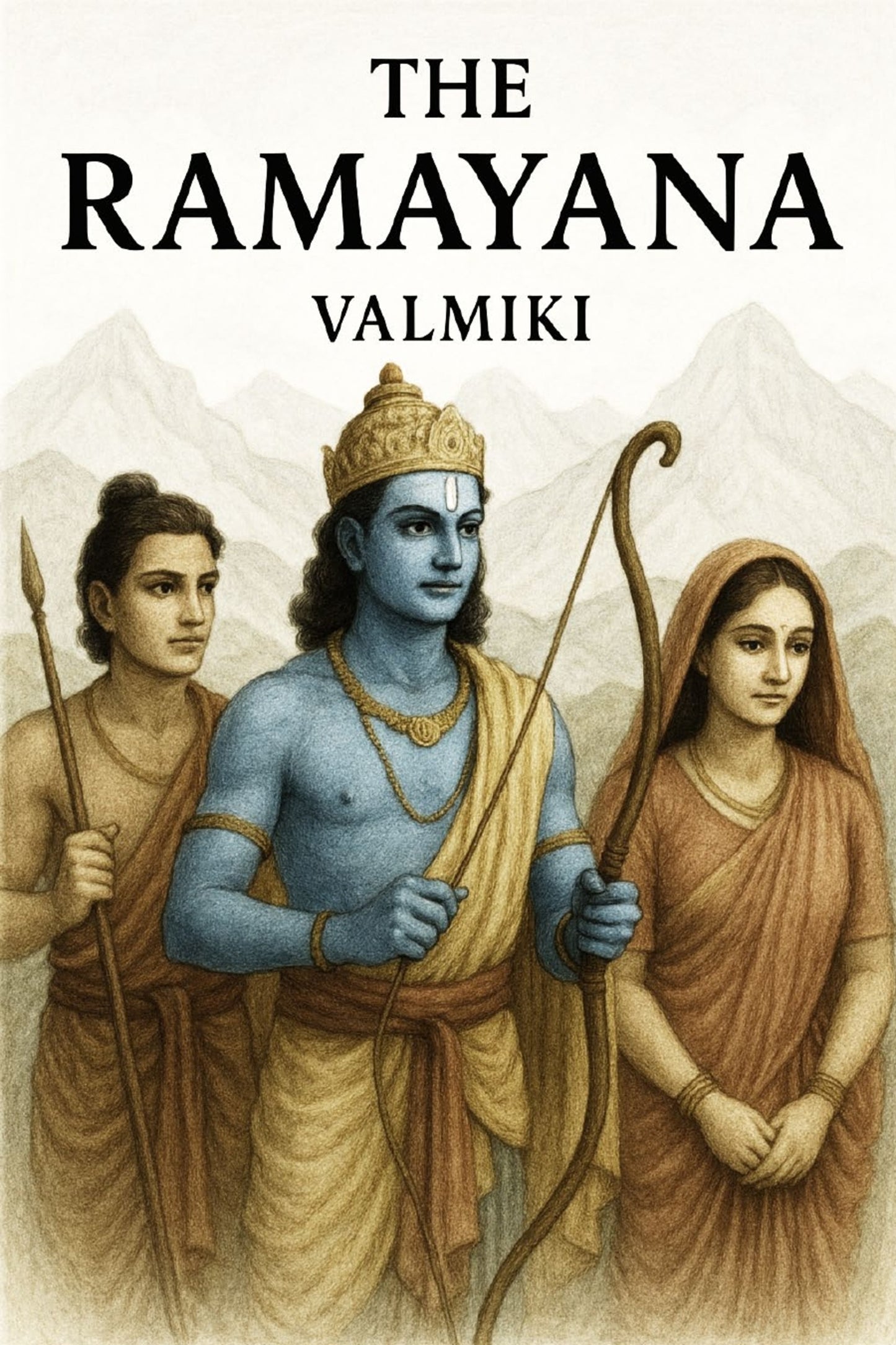
Book Description:
The Ramayana is one of the greatest epics of ancient India, traditionally attributed to the sage Valmiki. Composed in Sanskrit and comprising over 24,000 verses, the epic recounts the life of Prince Rāma — an incarnation of the god Vishnu — who is exiled from his kingdom and embarks on a heroic quest to rescue his wife, Sita, after she is abducted by the demon king Rāvaṇa. Presented in three volumes — Bāla Kāṇḍa and the beginning of Ayodhya Kāṇḍa in Volume 1; the later Ayodhya Kāṇḍa and Araṇya Kāṇḍa in Volume 2; and Kiṣkindhā Kāṇḍa, Sundara Kāṇḍa, Yuddha Kāṇḍa, and Uttara Kāṇḍa in Volume 3 — the narrative spans kingdoms, forests, and epic battles between divine beings and demons. Far more than an adventure, The Ramayana is a profound exploration of dharma (righteous duty), loyalty, honor, and the eternal struggle between good and evil. With its richly drawn characters, moral complexity, and spiritual depth, this timeless work has profoundly shaped the cultural and religious life of South Asia for millennia and continues to be retold and revered worldwide.
About Valmiki:
Valmiki is regarded as the legendary author of The Ramayana and is revered as the first poet (adi kavi) of Sanskrit literature. Believed to have lived around the 5th century BCE, Valmiki is said to have been a sage who transformed from a reformed outlaw into a revered seer and spiritual teacher. His poetic mastery and deep understanding of dharma gave rise to one of the foundational texts of Hinduism and Indian culture. Through The Ramayana, Valmiki established a literary tradition that has inspired countless adaptations in literature, art, dance, and theater across Asia and beyond.
